BRACE for it...
The BRACE Project (Biological Response to A Changing Environment) is a collaboration with Dr. Brian Branfireun (Western), the Ontario Ministry of Natural Resources and Forestry-Ontario Forest Research Institute (OMNRF-OFRI) and the Canadian Forest Service Great Lakes Centre (CFS-GLC).
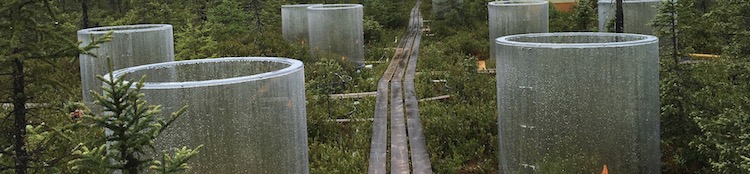
This large-scale field-based experimental system includes 32 experimental plots across two peatland sites that differ in vegetation, nutrient status and hydrology. Both sites have ambient control plots and warmed plots using open-topped chambers and an in-ground heating system.
BRACE was initiated in 2016, and each year we measure important baseline, monitoring and treatment response data through ongoing vegetation and soil fauna biodiversity surveys, and measures of decomposition dynamics.

Open-topped chambers (OTCs) at the two BRACE peatland sites. Above: the Sphagnum-dominated, nutrient poor fen site. Below: the Carex-dominated, intermediate nutrient fen site.

Publications from the BRACE Experimental Research Project
- Barreto, C., Buchkowski, R.W., and Lindo, Z. 2024. Restructuring of soil food webs reduces carbon storage potential in boreal peatlands. Soil Biology and Biochemistry 193: 109413. https://doi.org/10.1016/j.soilbio.2024.109413.
- Barreto, C.*, Branfireun, B.A., McLaughlin, J., and Lindo, Z. Responses of oribatid mites to warming in boreal peatlands depend on fen type. Pedobiologia – Journal of Soil Ecology (Virtual Special Issue on Response of Soil Biodiversity to Global Change) 89: 150772 https://doi.org/10.1016/j.pedobi.2021.150772 *graduate student
- Barreto, C.*, and Lindo, Z. Checklist of oribatid mites (Acari: Oribatida) from contrasting two boreal fens: an update on oribatid mites of Canadian peatlands. Systematic and Applied Acarology 26: 866–884. https://doi.org/10.11158/saa.26.5.4 *graduate student
- Tian, J., Branfireun, B.A., and Lindo, Z. Climate change alters peatland carbon cycling through plant biomass allocation. Plant and Soil 455: 53–64. DOI: 10.1007/s11104-020-04664-4
- Lyons, C.L.*, Branfireun, B.A., McLaughlin, J., and Lindo, Z. Climate warming increases plant community heterogeneity in boreal peatlands. Journal of Vegetation Science 31: 908–919. DOI: 10.1111/jvs.12912 *graduate student
- Lyons, C.L.*, and Lindo, Z. Above- and belowground community linkages in boreal peatlands. Plant Ecology 221: 615–632. DOI: 10.1007/s11258-020-01037-w *graduate student
- Asemaninejad, A.*, Thorn, R.G., Branfireun, B.A., and Lindo, Z. Vertical stratification of peatland microbial communities follows a gradient of functional types across hummock-hollow microtopographies. Écoscience 26: 249–258. DOI: 10.1080/11956860.2019.1595932. *graduate student
- Asemaninejad, A.*, Thorn, R.G., Branfireun, B.A., and Lindo, Z. 2018. Climate change favours specific fungal communities in Boreal peatlands. Soil Biology and Biochemistry 120: 28– DOI: 10.1016/j.soilbio.2018.01.029 *graduate student
- Barreto, C.R.A.*, and Lindo, Z. 2018. Drivers of decomposition and detrital invertebrate communities differ across a hummock-hollow microtopology in boreal peatlands. Écoscience 25: 39– DOI: 10.1080/11956860.2017.1412282. *graduate student
- Palozzi, J.E.*, and Lindo, Z. Pure and mixed litters of Sphagnum and Carex exhibit a home-field advantage in Boreal peatlands. Soil Biology and Biochemistry 117: 161–168. DOI: 10.1016/j.soilbio.2017.08.026 *graduate student
- Palozzi, J.E.*, and Lindo, Z. 2017. Boreal peat properties link to plant functional traits of ecosystem engineers. Plant and Soil 418: 277– DOI: 10.1007/s11104-017-3291-0 *graduate student
- Dieleman, C.M.*, Branfireun, B.A., and Lindo, Z. 2017. Northern peatland carbon dynamics driven by plant growth form — the role of graminoids. Plant and Soil 415: 25– DOI:10.1007/s11104-016-3099-3 *graduate student
- Asemaninejad, A.* Thorn, R.G., and Lindo, Z. Vertical distribution of fungi in hollows and hummocks of boreal peatlands. Fungal Ecology 27: 59–68. DOI: 10.1016/j.funeco.2017.02.002 *graduate student
- Asemaninejad, A.* Thorn, R.G., and Lindo, Z. Experimental climate change modifies degradative succession in boreal peatland fungal communities. Molecular Ecology. 73: 521–531. DOI: 10.1007/s00248-016-0875-9 *graduate student
- Del Giudice, R.* and Lindo, Z. Short-term leaching dynamics of three peatland plant species reveals how shifts in plant communities may affect decomposition processes. Geoderma 285: 110–116.DOI:10.1016/j.geoderma.2016.09.028. *graduate student
- Climate change effects on peatland decomposition and porewater dissolved organic carbon biogeochemistry. Biogeochemistry 128: 385–396. DOI: 10.1007/s10533-016-0214-8. *graduate student
- Dieleman, C.M.*, Branfireun, B.A., McLaughlin, J.W., and Lindo, Z. Enhanced carbon release from a northern poor fen under future climate conditions: Role of phenolic compounds. Plant and Soil 400: 81–91. DOI: 10.1007/s11104-015-2713-0. *graduate student
- Lindo, Z. Warming favours small-bodied organisms through enhanced reproduction and compositional shifts in belowground systems. Soil Biology and Biochemistry 91: 271–278. DOI: 10.1016/j.soilbio.2015.09.003.
- Dieleman, C.M.*, Branfireun, B.A., McLaughlin, J.W., and Lindo, Z. Climate change drives a shift in peatland ecosystem plant communities: Implications for ecosystem function and stability. Global Change Biology 21: 388–395. *graduate student
 and updated on